SpaceX, Anthropic, and OpenAI Are All Heading Public. Which Funds Hold the Most?
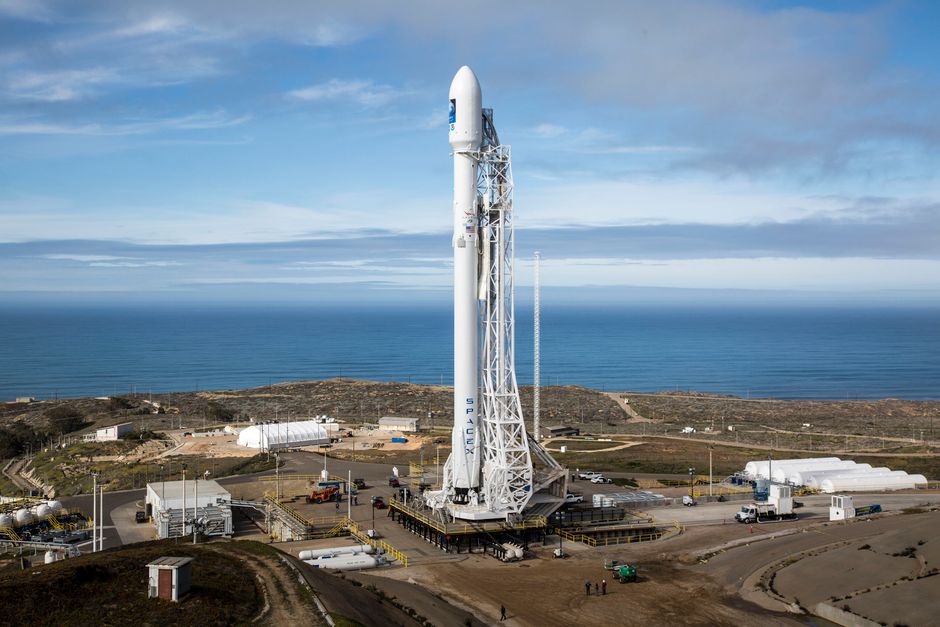
The three most valuable private companies in the world are walking toward the public markets within weeks of one another. SpaceX has its prospectus on file and is rumored to price around June 12; Anthropic filed confidentially on June 1; and OpenAI is expected to follow. Registered mutual funds and ETFs have quietly held pieces of all three for years, carrying them as private, hard-to-value stakes and disclosing them each quarter in their N-PORT filings. A listing changes what those stakes are: it converts a fund's internal fair-value mark into a public price, and — once lockups lift — into stock the fund can actually sell. The disclosures below, current through March 31, 2026, show which funds are sitting on the most to convert.
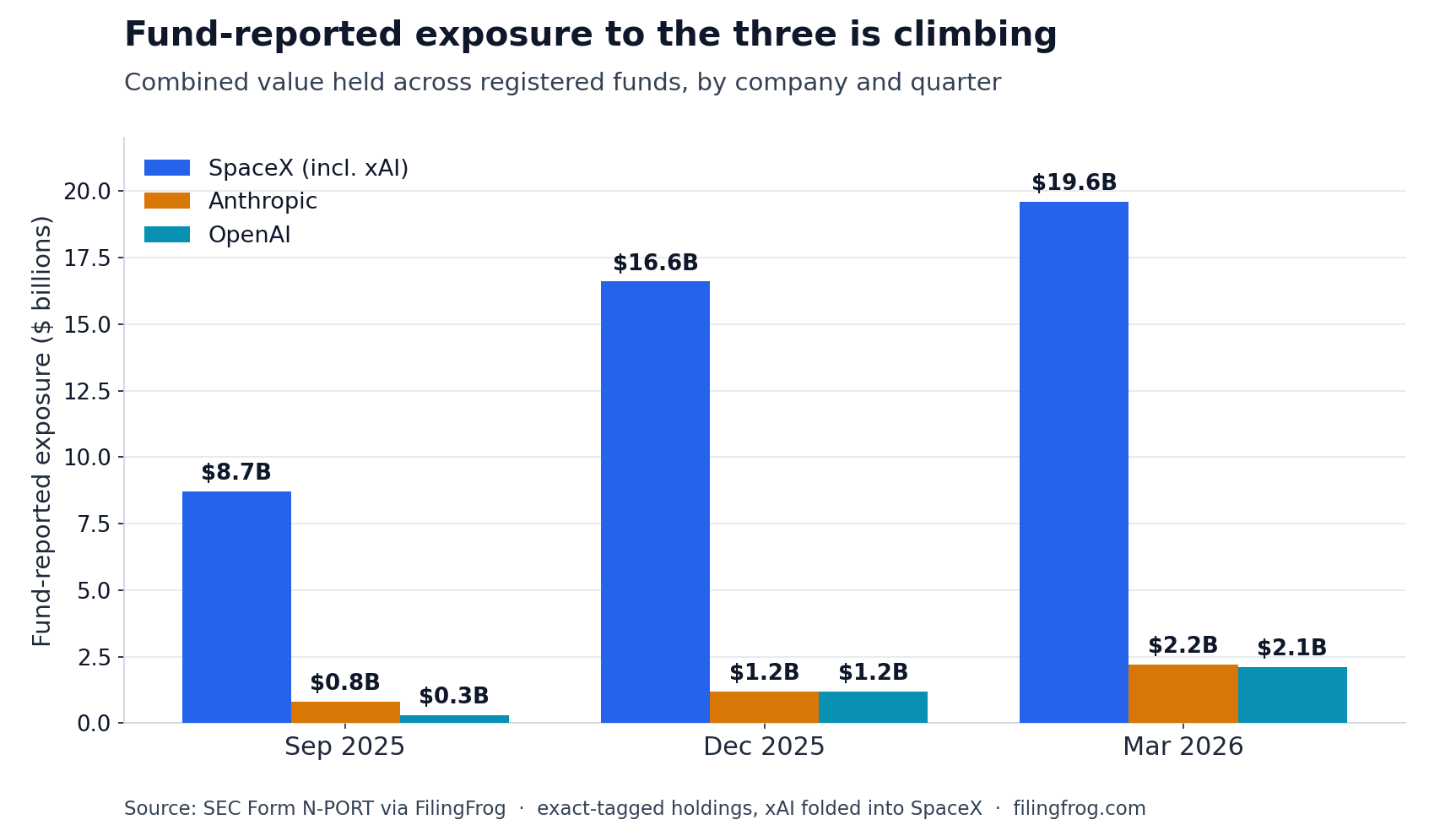
The combined pile has grown every quarter. SpaceX, with xAI folded in, sat near $19.6 billion of fund-reported value at the end of March — close to ten times the Anthropic or OpenAI totals, which reached about $2.2 billion and $2.1 billion. But the dollar size of a position says little about how much a single listing matters to the fund holding it. For that, the more telling number is weight: how large the stake looms as a share of the fund's net assets. Measured that way, the leaderboard looks very different from the dollar one.
The xAI line has nearly disappeared
A quarter ago, xAI was its own entry in fund portfolios — 66 funds reported close to $2 billion of it at the end of December. By March 31, that had collapsed to eight funds and $184 million. The reason isn't selling. SpaceX acquired xAI in February 2026, and most funds simply re-tagged the position as SpaceX. The handful still carrying it under the old name — a few BlackRock and T. Rowe Price funds — are counted here as SpaceX, since that is now what they own.
For a few funds, SpaceX is a third of everything
SpaceX is where the weights run highest. Baron Partners Fund carries SpaceX at 37.5% of net assets — more than a third of the fund riding on one listing. Three more Baron funds sit above 20%. At the other extreme, Fidelity Contrafund holds the largest dollar stake of anyone — roughly $8.0 billion — yet that is only about 5% of its $158 billion in assets. Same company, opposite stakes: for Baron a listing is a defining event, for Fidelity a rounding adjustment.
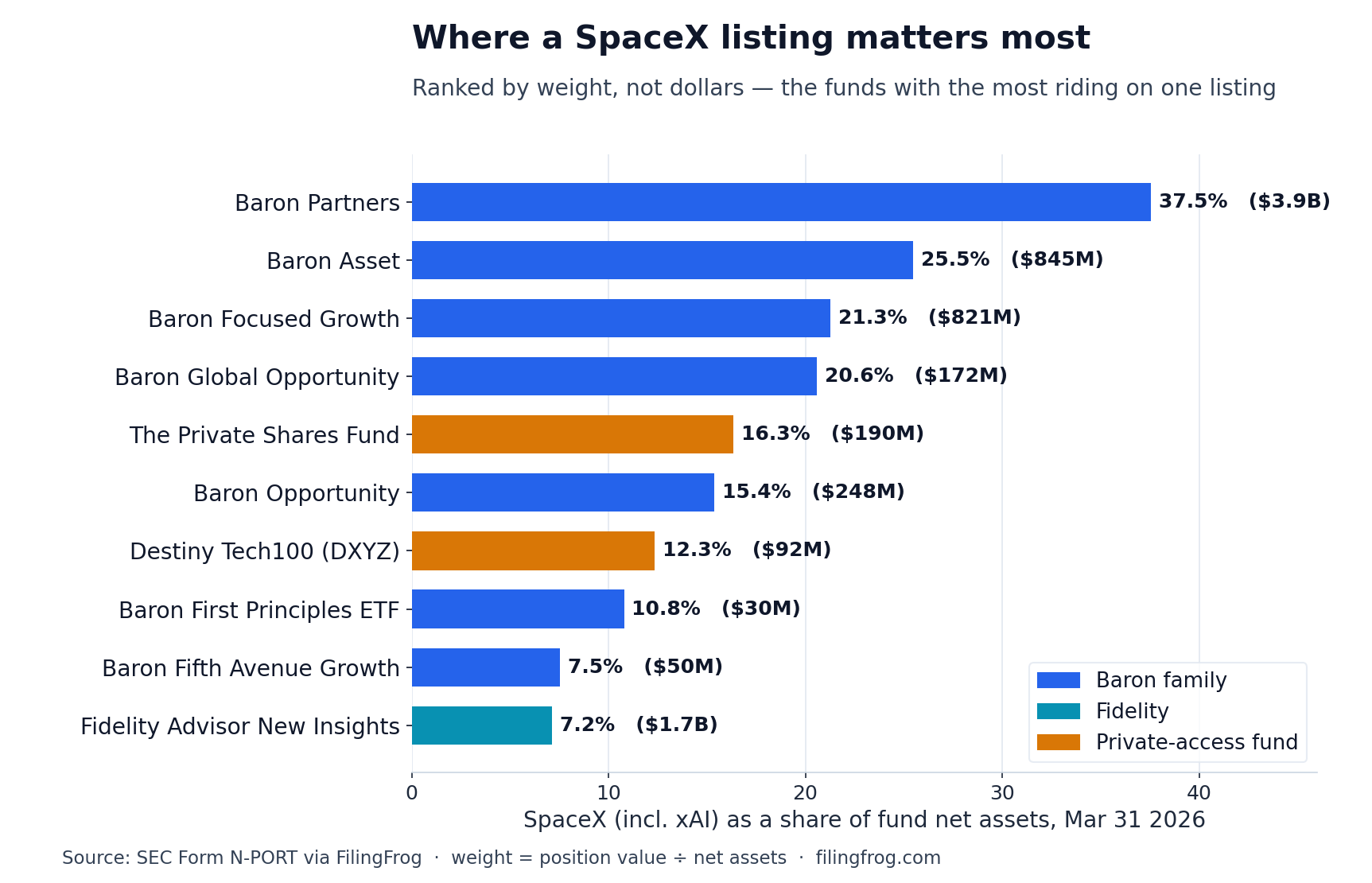
Ranked by weight, the funds with the most riding on a SpaceX listing are almost entirely Baron funds and dedicated private-access vehicles:
- Baron Partners Fund — 37.5% of net assets ($3.9B)
- Baron Asset Fund — 25.5% ($845M)
- Baron Focused Growth Fund — 21.3% ($821M)
- Baron Global Opportunity Fund — 20.6% ($172M)
- The Private Shares Fund — 16.3% ($190M)
- Baron Opportunity Fund — 15.4% ($248M)
- Destiny Tech100 (DXYZ) — 12.3% ($92M)
- Baron First Principles ETF — 10.8% ($30M)
- Baron Fifth Avenue Growth Fund — 7.5% ($50M)
- Fidelity Advisor New Insights Fund — 7.2% ($1.7B)
Anthropic's biggest weight sits in a fund few have heard of
By weight, the most concentrated Anthropic holder is the tiny Innovation Access Fund, where a $13 million stake is 25.8% of a $48 million fund — high conviction, but a small absolute bet. The holder that matters at scale is Coatue Innovative Strategies Fund, which carries Anthropic at 9.9% of net assets, roughly $480 million — by far the largest committed position in the company. After that the weights thin out quickly: a cluster of BlackRock private-markets trusts hold it at 2–3.5%, and the big diversified funds carry it as a fraction of a percent. American Funds Insurance Series Growth Fund reports $384 million of Anthropic, but in a $50 billion fund that is under 1% — a large check that barely moves the portfolio.
Anthropic exposure nearly doubled over the quarter, from about $1.2 billion to $2.2 billion, and the number of funds holding it rose from 29 to 36 — seven funds entirely new to the name, with no prior holder exiting. Ranked by weight:
- Innovation Access Fund — 25.8% of net assets ($13M)
- Coatue Innovative Strategies Fund — 9.9% ($480M)
- BlackRock Technology & Private Equity Term Trust — 3.5% ($31M)
- BlackRock Science & Technology Trust — 3.0% ($40M)
- BlackRock Science & Technology Term Trust — 2.4% ($40M)
- T. Rowe Price Global Technology Fund — 1.3% ($71M)
- T. Rowe Price Capital Appreciation Fund — 0.5% ($318M)
OpenAI is a T. Rowe Price book
OpenAI is the most thinly weighted of the three almost everywhere it appears — and the most concentrated in one house. Coatue again leads on weight, at 3.3% of net assets in its directly-tagged stake — and it holds roughly $336 million more OpenAI under a second issuer name the company-level tally doesn't capture, which is why it towers over the combined view further down. Below Coatue the list is T. Rowe Price nearly all the way down: seven different T. Rowe funds hold OpenAI, more than any other manager carries across all three companies. T. Rowe Price Blue Chip Growth Fund holds the largest dollar stake, about $453 million, though at 0.8% of the fund a listing would barely register on its returns. OpenAI exposure rose about 70% over the quarter, from $1.2 billion to $2.1 billion, but only two new funds joined — most of the increase came from existing holders carrying a larger stake. Ranked by weight:
- Coatue Innovative Strategies Fund — 3.3% of net assets ($160M)
- T. Rowe Price Global Technology Fund — 1.2% ($68M)
- T. Rowe Price Communications & Technology Fund — 0.9% ($69M)
- T. Rowe Price Institutional Large-Cap Core Growth Fund — 0.8% ($20M)
- T. Rowe Price Blue Chip Growth Fund — 0.8% ($453M)
- T. Rowe Price Growth Stock Fund — 0.4% ($185M)
- Fidelity Contrafund — 0.3% ($408M)
Funds built to hold the unlisted
For the giant diversified funds, these three companies are small corners of a mostly-public portfolio. A different set of funds is built the other way around — most of what they own is already private, and the three imminent IPOs are simply the holdings closest to the exit. These are the vehicles an ordinary investor can actually buy for pre-IPO exposure: the exchange-listed Destiny Tech100 (DXYZ), the BlackRock private-markets trusts, and interval funds such as Coatue Innovative Strategies, The Private Shares Fund, and StepStone Private Venture and Growth Fund. And the three IPOs are only the front of the line: behind them these funds carry a deeper book of recognizable private names — Databricks, Stripe, Canva, Revolut, PsiQuantum, ByteDance — that they are also waiting to monetize.
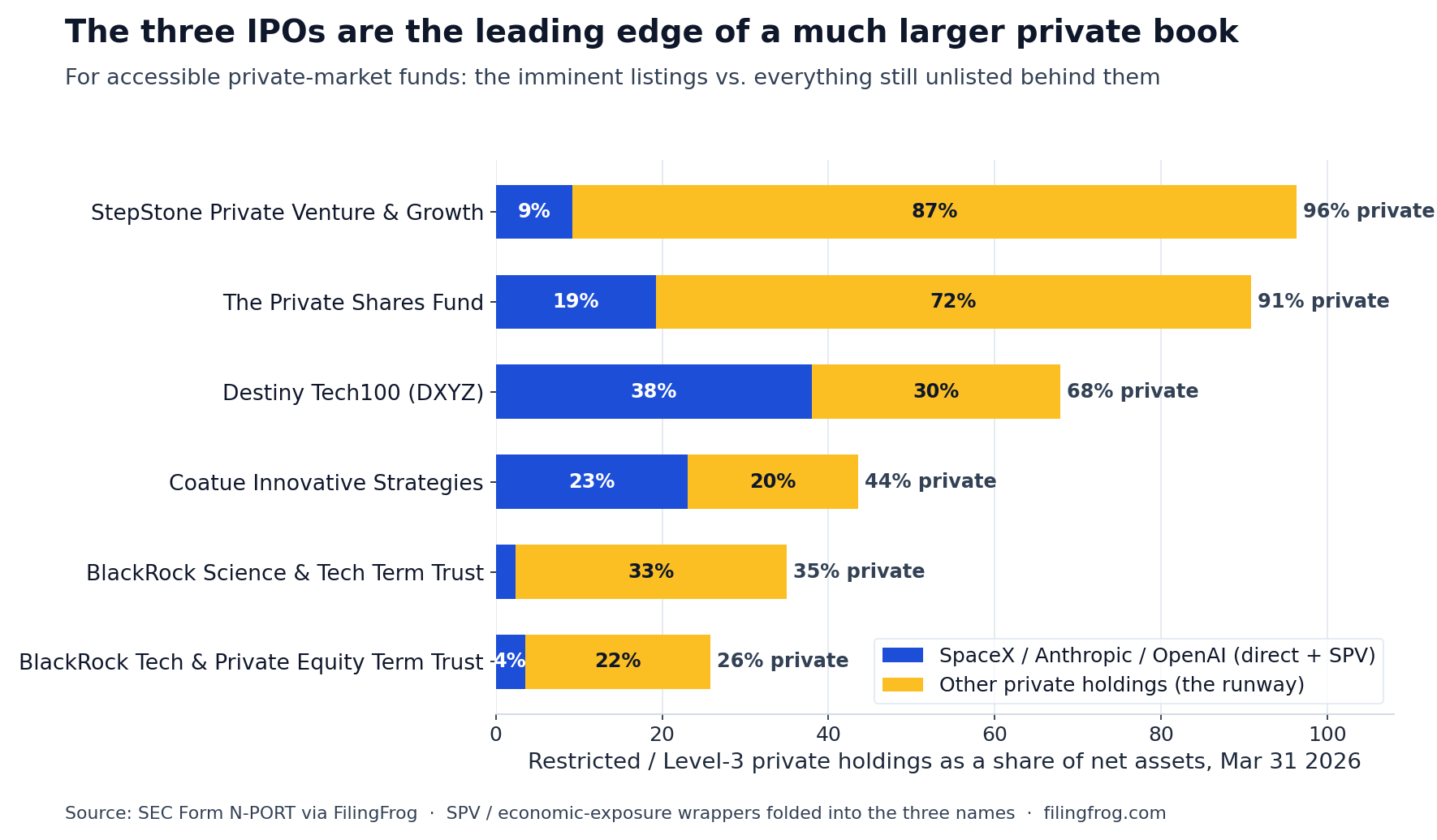
Two patterns stand out. Destiny Tech100 (DXYZ) is the most IPO-loaded of the group: counting both its direct stakes and the SPV wrappers it uses, about 38% of the fund is tied to SpaceX, Anthropic, and OpenAI, with another 30% in other private names. The combined three-name bet is the highest of any accessible fund. Coatue is the only fund that holds all three at meaningful weight — roughly 23% of its $4.8 billion across the trio, sitting on top of Stripe, Revolut, Databricks, and Canva. For these two, the coming listings would convert a large, concentrated slice of the fund from estimated marks into quoted prices.
The opposite shape is just as interesting. StepStone and The Private Shares Fund are 96% and 91% private, but the three IPO names are only 9% and 19% of that — the overwhelming majority of their books is a long tail of other unlisted companies that will look for the exit in later years. A few recognizable names surface in it — Databricks and Stripe at StepStone; Grubmarket, Arctic Wolf, and a Databricks stake at The Private Shares Fund — but most of the runway is smaller venture positions held through fund-of-fund and SPV wrappers. They have, in other words, the most runway left. The BlackRock trusts sit in between. The Science & Technology Term Trust carries little of the three names (2%) but holds Databricks at 16% of the fund, alongside PsiQuantum, ByteDance, and Grubmarket; the Technology & Private Equity Term Trust holds no Databricks at all, leaning instead on PsiQuantum, Deepgram, Discord, and Grammarly. For both, the monetization story is mostly still ahead, in companies that haven't filed yet.
Explore Fund HoldingsNotes
Holdings come from N-PORT filings, which registered funds submit monthly; figures here cover September 30 and December 31, 2025 and March 31, 2026. Private-company positions are carried at Level 3 fair value — estimates set by each fund, not market prices — and counted here only when a fund flags them as restricted or illiquid. Weight is a position's value divided by the fund's net assets. SpaceX figures fold in xAI, which SpaceX acquired in February 2026; eight funds still reported xAI separately at quarter-end and are counted with SpaceX.
Company-level totals use exact issuer tags. The fund-by-fund runway figures additionally capture two kinds of holdings the company-level tally misses: direct stakes filed under a name variant — Coatue's largest OpenAI position is reported as "OpenAI Global LLC Series A 3," a different preferred series than its tagged line — and genuine SPV or "economic-exposure" wrappers that hold the same companies through a separate vehicle, common in funds like Destiny Tech100. Both are counted here, so a fund's runway exposure can exceed its tagged total; look-alike names that actually hold different companies (OpenEvidence, Anthropics Technology, Open Space Labs) were excluded by hand. Because of those name variants, the company-level totals above understate true exposure somewhat — OpenAI by roughly $336 million of directly-held stock in particular. A public listing converts a fair-value mark into a quoted price, but funds typically cannot sell until post-IPO lockups expire, so a listing marks the gain before it can be realized.
The data predates the events now in the news: Anthropic's late-May round near a $965 billion valuation and its June 1 confidential filing, SpaceX's prospectus targeting a valuation around $1.8 trillion, and OpenAI's pending public filing. Cross-fund views for each company are at SpaceX, Anthropic, OpenAI, and xAI; individual fund holdings are in the fund section.