In 2025, Congress and Wall Street Made the Same Semiconductor Bet

Two groups of investors have almost nothing in common. One is a few hundred members of Congress, who disclose their stock trades within weeks of making them under the STOCK Act. The other is the thousands of institutional managers — hedge funds, asset managers, pensions — that report their positions every quarter on Form 13F. Through 2025 and into early 2026, both ended up leaning the same way: toward semiconductors and the hardware behind the AI build-out.
Wall Street kept adding to the chip names
Across the largest chip and AI-infrastructure names, institutional ownership kept widening. Comparing how many managers held each stock at the end of the second quarter of 2025 with the first quarter of 2026, holder counts rose for eleven of the twelve names in the group.
The clearest move was in memory. Micron Technology (MU) gained institutional holders faster than any name in the group, up about 61% over three quarters. Micron has said its high-bandwidth memory — the kind that sits beside AI accelerators — is sold out through 2026, and the equipment makers that supply that build-out moved with it: Lam Research (LRCX) rose 41%, ASML Holding (ASML) 27%, and Applied Materials (AMAT) 26%.
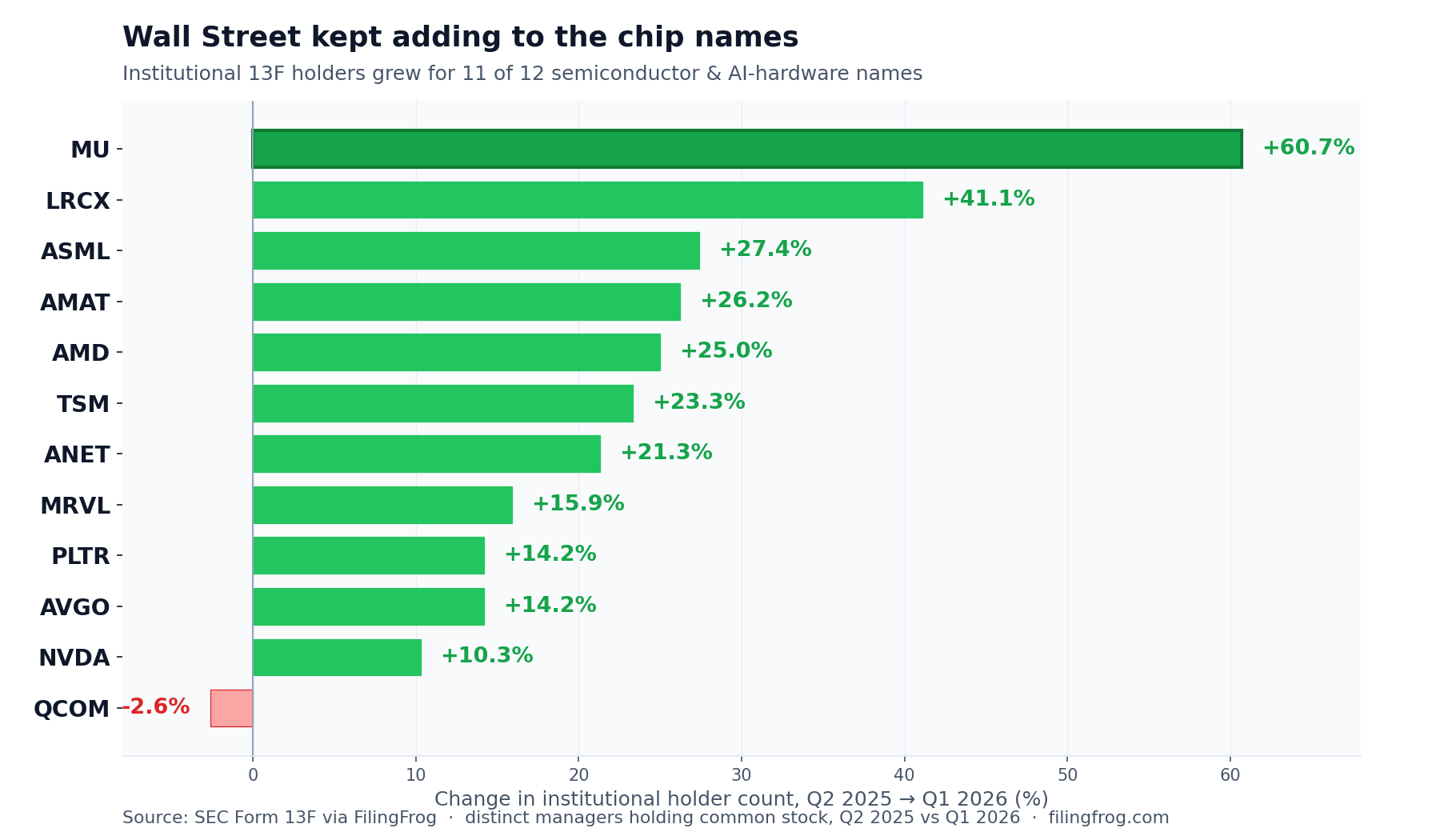
The rest of the group followed. Advanced Micro Devices (AMD) added holders (+25%), as did Taiwan Semiconductor (TSM) (+23%), Arista Networks (ANET) (+21%) and Marvell Technology (MRVL) (+16%). Even the most crowded names still grew: Nvidia (NVDA), already held by more than 5,800 managers, added another 10%. The one name that lost holders was Qualcomm (QCOM), down about 3% — less tied to the data-center trade than the rest.
The same names showed up in congressional disclosures
The same stretch shows up in congressional trading, at a far smaller scale but pointed in the same direction. Over the twelve months through June 2026, 32 members of Congress reported trading this same twelve-name group — 143 disclosed purchases against 101 sales. Counted by how many members bought each name, the buying spread across the group:
- Nvidia (NVDA) — 9 members bought
- Advanced Micro Devices (AMD) — 8 members bought
- Broadcom (AVGO) — 6 members bought
- Palantir (PLTR) — 6 members bought
- Taiwan Semiconductor (TSM) — 6 members bought
- Arista Networks (ANET) — 5 members bought
On the semiconductor names in particular — AMD, Taiwan Semiconductor, Applied Materials, ASML and Arista among them — members buying outnumbered members selling. It is the same tilt the quarterly institutional data shows, arrived at from an entirely separate set of filers.
The timing lined up
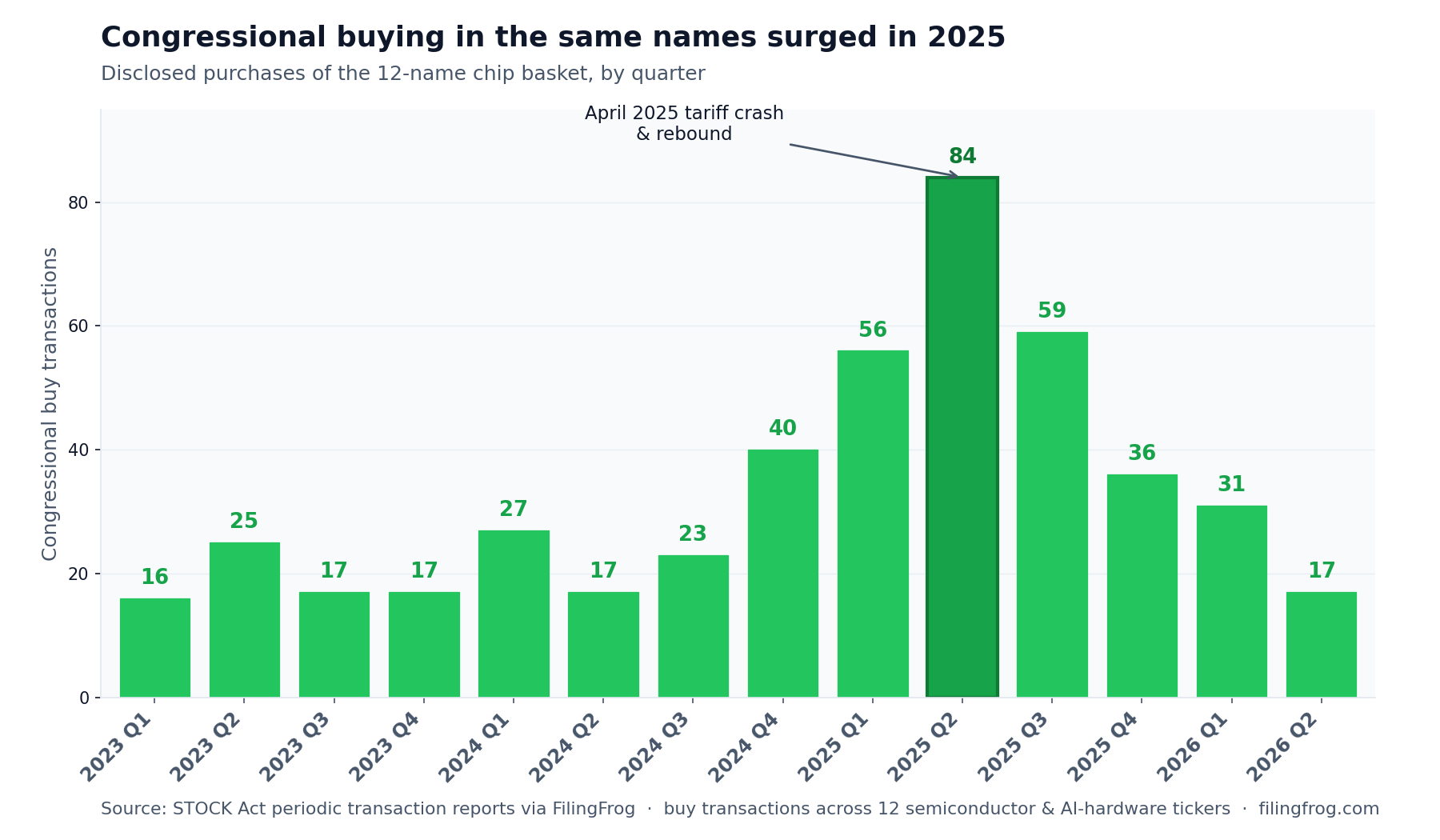
What stands out is when the congressional buying happened. Purchases in these names ran at a low, steady rate through 2023 and most of 2024 — roughly 16 to 27 a quarter. Then they climbed: 56 in the first quarter of 2025, and 84 in the second, the busiest quarter for this group by a wide margin.
That second quarter held the sharpest market event of the year. New tariffs announced on April 2, 2025 sent stocks into a four-day slide — one of the five steepest two-day declines since 1950 — before a 90-day pause on April 9 set off the S&P 500's biggest one-day gain since 2008. The disclosed purchases cluster into exactly that window.
Institutional money was moving the same way over the same stretch, just measured on a different clock. Because 13F reports arrive quarterly, the institutional build shows up as a steady widening of holder counts across 2025 rather than a single dated spike — with the largest jumps in the memory and equipment names landing in the last quarter of 2025 and the first of 2026.
Where the two didn't line up
The overlap isn't total, which is part of what makes it worth watching. Congressional trading in these names wasn't one-directional — for roughly every three purchases there were two sales, and on Nvidia the members selling narrowly outnumbered those buying. Micron is the sharpest split: institutions added holders to it faster than to any other name in the group, while among members of Congress the sellers modestly outnumbered the buyers. And Qualcomm is the one name both sets of investors cooled on — the only stock in the group to shed institutional holders over the period.
Explore Ownership Changes Browse Congressional TradesNotes
Institutional figures come from SEC Form 13F filings, comparing holdings as of June 30, 2025 and March 31, 2026; holder counts are the number of managers reporting each company's common stock. Congressional figures come from periodic transaction reports filed under the STOCK Act by the House and Senate, covering July 2025 through June 2026. Members disclose amount ranges rather than share counts or prices, so the congressional figures here are counts of disclosed transactions and distinct members, not dollar volumes. A share of congressional trading is executed by financial advisors in managed accounts, so a disclosed transaction is not always a member's own decision. The twelve-name group is NVDA, AMD, AVGO, TSM, MU, LRCX, AMAT, ASML, ANET, MRVL, PLTR and QCOM. Institutional ownership changes across all tracked securities are available in the ownership trends section. Congressional trades by member and by company are in the congressional trading section.